What would it mean if women were paid as much as men? (DRAFT)
Draft! Please do not link here!
Update, April 20: Rrevised version has been posted on Qworky’s blog, Better Software/Better World
Jon's blog, currently experimenting with a readable but rather gray theme
Draft! Please do not link here!
Update, April 20: Rrevised version has been posted on Qworky’s blog, Better Software/Better World
Update, December 17: Thanks to all for the excellent feedback, here and in email!
I’ll be splitting this into two posts, which will appear on the Qworky blog
Thanks also to those who expressed interest … if you’d like to get involved, stay tuned — or get in touch via the contact information at the bottom of the post.
As a company we view diversity as a vital ingredient to sustained business success. We value unique perspectives and traditionally under-represented viewpoints in the software design process. We welcome collaborators from every walk of life. We welcome people of any gender identity and expression, race, ethnicity, sexual orientation, experience level, discipline, educational background, culture, and political opinion.
– Qworky’s draft diversity statement
Continue Reading »
We received 189 valid proposals for talks at Expo Showcase. A few people, men and women, submitted two proposals, but the vast majority submitted just one. Of these 189, only 41 (or 22% of the total) were from women, with 147 proposals submitted by men. I have no reason in particular to offer for this. Perhaps women would like to comment on this blog about why a two month open call for proposals for anyone with a good idea for a five minute talk about Government 2.0 was dominated by 78% men.
– Mark Drapeau’s Government 2.0 Expo: Women by the Numbers
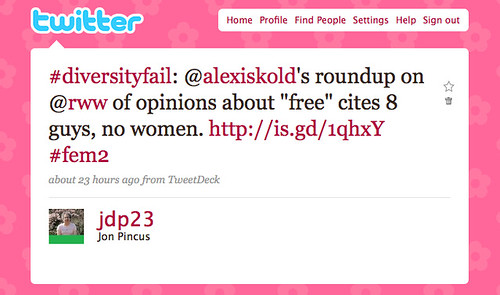
The women in technology community has been doing a great job of highlighting lack of diversity in conference speakers, using mechanisms like the #diversityfail Twitter hashtag and act.ly. Mark’s post provides some interesting data on how an O’Reilly conference he’s co-chairing wound up with more than two-thirds of the presenters being male. While I’m not actually a woman, I’d nonetheless like to take him up on his invitation for discussion about how the submission process became so male-dominated.
How can an entrepeneur planning a startup that’s going to develop some revolutionary software that relates to how people work together discover truly game-changing product and business model possibilities? One approach is to look at a situation in a different way than everybody else. Easier said than done, typically … unless you’re lucky enough to discover a collective blindspot in current thinking.
Scott Page’s book The Difference highlights the importance of diversity in situations like this. The way I think of it is that a non-diverse crowd will fail to explore a lot of the possibilities. Strategically the best opportunties are likely to be in the areas that the are getting marginalized today. So whenever I see a #diversityfail related to the “web 2.0″ and mobile technology/business world, my ears perk up and I start paying attention.
7-8PM Pacific/10-11PM Eastern
Draft agenda and discussion here
Please join us!
Twitter is an opportunity to engage with communities currently marginalized by the “progressive blogosphere”
– Tracy Viselli and Jon Pincus, The #p2 Hashtag and Strategies for Progressives on Twitter on The Exception
#p2 is a resource for progressives who prioritize diversity and empowerment
– #p2’s wiki and Twitter profile
Because #p2 (aka “progressives 2.0″) is the closest thing to a broad communication mechanism for progressives on Twitter so far, I’m not sure how many people realize that the primary focus is on diversity. So here’s some background reading about #p2 for Thursday’s tweeting on how progressives can organize more effectively on Twitter.
Let’s start with a question that I think doesn’t get asked enough.
According to new data from the Bureau of Labor Statistics, in 2007 the ratio of women’s and men’s median annual earnings reached almost 78 cents on the dollar for full-time year-round workers, up from just under 77 cents in 2006. This is the narrowest the wage gap has ever been, but it’s only an additional one cent on the dollar. One cent is chump change. It isn’t real change.
– from AAUW’s Equal Pay Day, April 28
African-American women earn 62¢ and Latinas earn 53¢ for every dollar earned by white, non-Hispanic men. #fairpay #fem2 #p2
– @NWLC on Twitter
One of President Obama’s first actions in late January was signing the Lilly Ledbetter Fair Pay Act into law. That’s only a first step, though; the next battle in the fight against wage discrimination is the Paycheck Fairness Act. The PFA updates the 45-year-old Equal Pay Act in many important ways, and passed the House with strong bipartisan support, and is currently before the Senate as S.182.
The AAUW’s site has a bunch of ways you can help: call your Senators, wear red,* blog about it, share on Facebook and join their group and cause, and tweet about it using the #fairpay hashtag. It’s all important; do as much as you can. There are a couple of things I’d specifically like to highlight.
Let’s start with Twitter, where this is another great opportunity for hashtag-based diversity activism. Activity via #fairpay accomplishes several things. Most obviously, it raises awareness: whenever you tweet, all your followers are reminded of the wage gap. If some of the Twitterati start retweeting, or there’s enough activity that #fairpay winds up in the top 10 “trending” hashtags, a lot more people will see it. So tweet away! If you’re not sure what to say, the National Women’s Law Center has some tweeting points you can use as inspiration.

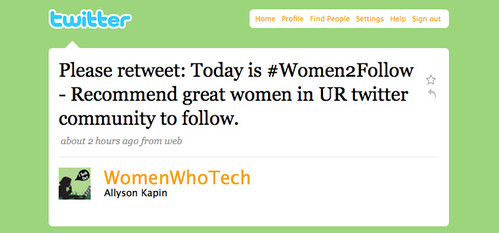
Today, on Twitter, I saw another woman, Allyson Kapin (who goes by @WomenWhoTech), get frustrated when she saw a list of “top” folks in social media that, once again, omitted all but one woman…. Soon after, a discussion ensued, and, within minutes, Kapin started a new “event” on Twitter…
– Denise Graveline on The Eloquent Woman, February 25
The idea behind #Women2Follow Wednesdays is straightforward: to recognize and promote women in the technology and social media field — and help people find each other. If you’re on Twitter, it’s easy to participate.
Like I said, easy. Here are my recommendations over the last three weeks.
Sunday night, Agency.com relaunched the Skittles* website as a redirect to social network sites. The main page showed a Twitter search for “skittles”. Other links went to flickr, Facebook, and Wikipedia.
Hilarity ensued, with “#skittles” shooting to the #1 Twitter term for the day. With over 4000 blog posts and positive articles in the Wall Street Journal, LA Times, the Financial Times and Advertising Age, it’s a viral marketing success story for the ages! Emily Steel’s Skittles Cozies Up to Social Media, David Amaro’s Skittles Goes Modernista! With A Distributed Experience on Logic and Emotion and Tiphereth Gloria’s Why it takes balls to Skittle on Digital Tip are some thought-provoking discussions.
What’s particularly fascinating to me, though, is something Katrin Verclas of MobileActive.org pointed out on the Progressive Exchange mailing list: the significant gender differences in people’s reaction.
Sure enough, the pattern is there in blogosphere as well. I classified the opinions in Skittles articles on the Google News page and a handful of the top hits on Google Blogs as positive, neutral, and negative. The results:
And when I say “negative”, whoa baby. David says “By just about any rational indication, Skittles went too far.“ Noah characterizes it as “generally A Bad Idea” and “a gaffe”. Harry sees it as “social-media marketing nihilism.” Riche thinks it’s “the worst strategic decision I have seen online in a long time.” Yow.
There’s no easy way to know how much this reflects an actual difference in opinions. It could be that women avoid harsh criticisms in favor of neutrally-worded posts like Allyson Kapin’s and Shannon Nelson’s raising questions about the effectiveness of Skittles’ strategy. One way or another, though, it’s really striking.
Twitter is an opportunity to engage with communities currently marginalized by the “progressive blogosphere”.
– Tracy Viselli and Jon Pincus, Strategies for progressives on Twitter in The Exception
There’s an important lesson here for anybody trying to understand social media, and Twitter in particular. Make sure you’re getting a range of opinions — as well as gender-based differences, there are also age-based differences. In particular, if you’re getting your political news from the male-dominated “progressive” or “conservative” blogospheres (or the mainstream media and pundits who look to the big bloggers as being on the cutting edge), be aware of the possibility that you’re getting a distorted view of social network sites and their value.**
Today Skittles’ home page instead redirects to their Facebook page. Any bets on how people will react?
jon
PS: in the credit where credit is due department, Modernista! took a similar approach with their own web site almost a year ago. Allison Mooney’s Modernista!’s new siteless site on pfsk has more.
Skittles photo from ambibambie39507’s flickr page,
Twitter graphic from joomlatools on flickr,
both licensed under Creative Commons
* a horrible trans-fat-based chemically-tasting candy, if you ask me, although some people loooooove them.
** see for example my comments in Petitions are soooooo 20th century.
I wanted to expand on my remark in yesterday’s post about the gender ratio on #p2 staying “relatively well-balanced” with some statistics from the 24 hours ending at noon (Pacific time) today. While this is only one data point — and over a weekend, too — it’s roughly in line with the other measurements I’ve been makingover the last week.
For about 80-90% of the people participating, it’s possible to able to infer the like gender of the tweeter based on self-descriptions (”mom” or “dad” for example), visual information, name, and so on. Of course there’s room for error here,* so don’t treat this as gospel; and my apologies to anybody I inadvertently misclassified. Still, it’s enough to get some useful information.
![]()
Update: #topprog Tweetup : Tuesday Night 7:30 EST : Subject – topprog.org features, functionality, and community. Please Retweet! H/T @cacardinal
The new #topprog Twitter hashtag for progressives continues to make progress with a good range of topics and tweeters — including big names like @blogdiva, @PunditMom (who’s moderating a breakout session at fem2pt0 tomorrow), and @JoeTrippi.
The progressive blogosphere’s ignoring it, of course,* but the conservatives of #tcot are nervous enough that they’re already labelling it a #fail, thinking about flooding it, and coming up with euphemisms for trolling. And in fact @The_Anti_Guru’s “active engagement” probably accounts for over 50% of the traffic, counting replies. Guy attempts to disrupt and dominate conversation in potentially-woman-friendly-space, film at 11!
Gender issues aside, a lot of people are skeptical whether it’s possible to have meaningful conversations on Twitter. Won’t the loudest voices drown everybody else out? The three loudest tweeters yesterday had 46, 30, and 29 tweets yesterday. As calibration, @drdigipol, aka Alan Rosenblatt, who as the creator of the list presumably has as much to say as anybody else, had 7. So it’s easy to overlook @lizandra311’s updates on the Rootscamp in Philadelphia, or the occasional posts from @blogdiva, @Heardtfelt, @myrnyatheminx, @GetFISARight and others.
It still bugs me that Steve Elliot’s Get FISA Right: Last Chance To Vote Against Domestic Spying was buried by pro-surveillance diggers after I foolishly twittered it to the #tcot (Top Conservatives on Twitter) channel. So when I got Alan Rosenblatt’s email about a new #topprog hashtag, my immediate response was that we should think about how to use it for information diffusion including posts that might be worth digging. Not that I’m competitive or anything ….
Of course as Twitter Vote Report and the Motrin Moms have shown, Twitter hashtags are potentially useful for far more than that. From the Get FISA Right perspective, for example, it’s another great way of broadcasting our dailyish update — and the same’s true for every other grassroots campaign out there.
One especially intriguing aspect of this to me is that Twitter is a far less male-dominated environment than digg, email and the blogosphere — and indeed the early posts to #topprog include @WomenWhoTech, @nerdette, @PunditMom, @myrnathemynx and many others. So it’s a great chance for a key piece of progressive infrastructure where feminists and womanists — and women in general — can participate on a fairer basis.
DRAFT! Still under revision!
First draft July 26; substantial revisions August 2.
Originally written as a three-part conclusion to
Gender, race, age, and power in online discussions, chapter n
The “mutual guest-blogging” project I’ve been leading on OpenLeft has been taking place in the context of a surprising amount of coverage of diversity issues in the blogosphere in the mainstream media recently. Articles like Amy Alexander’s The Color Line Online: Minority Bloggers Fight Inequality in The Nation and Karen Jesella’s Blogging’s Glass Ceiling in the New York Times (nicely analyzed by PhysioProf in Teh Laydeez Are So Cute When They Try To Blog on Feministe) are the highest-profile treatments I’ve seen of this topic since Jose Antonio Vargas’ A Diversity of Opinion, if not of Opinionators in the Washington Post a year ago.
It’s also come up in a broader context in stories like Jose’s Liberal Bloggers Brace for Victory in the Washington Post, and Kirsten Powers’ Net-roots Ninnies: Dem’s Left Dum Bam Slams in the New York Post.* As Kirsten, who’s also a Fox News reporter, says:
Newsflash to the netroots and the media (which seems perpetually confused on this issue): The netroots are not the base of the Democratic Party.
Overwhelmingly white, male and highly educated, they’re a loud anomaly in a party that’s wholly dependent on the votes of African Americans, women and working-class whites.
Not everybody sees it that way. Chris Bowers’ OpenLeft post The Myth Of The Non-Diverse Netroots, for example, presents a different perspective. (See Is netroots non-diversity a myth?, as well as my responses in Chris’ thread, for my opinion.) In the aftermath of the nastiness with race and gender we’ve seen so far this election year, with the McCain campaign and New Yorker throwing gasoline on the fire on the race and gender front and a lot of Democrats doing their best to get equally nasty about the age dimension, it’s certainly a good discussion to be having.