privacy

Happy f—ing Bill of Rights Day

the Bill of RightsBoth houses of Congress have passed the #NDAA codifying indefinite detention — and Obama’s happy with the language, so won’t be vetoing it.

Meanwhile even as I write this, the House is debating #SOPA.

Remember back in 2006-8 when the Bush Administration rammed through PATRIOT Act reauthorization and FISA? Obama was on the right side for a while — at least until July 2008, when he broke his promise to filibuster. Now, he’s continuing and building on Bush policies. Senator Chris Dodd was heroic on FISA; now, he’s working for the MPAA and using China’s internet policies as a blueprint for the US. And how about Patrick Leahy, bulwark of civil liberties — and co-sponsor of the Senate equivalent of SOPA?

It’s not that I think the Republicans are any better on the whole. Both parties have a few standouts on civil liberties — Wyden, Nadler, the Pauls. But on the whole, the political establishment continues to show itself remarkably unconcerned with Americans’ rights.

Here’s hoping that in 2012 we’ll start to do something about it.

Tales from the Net
political
privacy

Comments (0)

Permalink

Save the Rave: Stop Surveillance in San Francisco

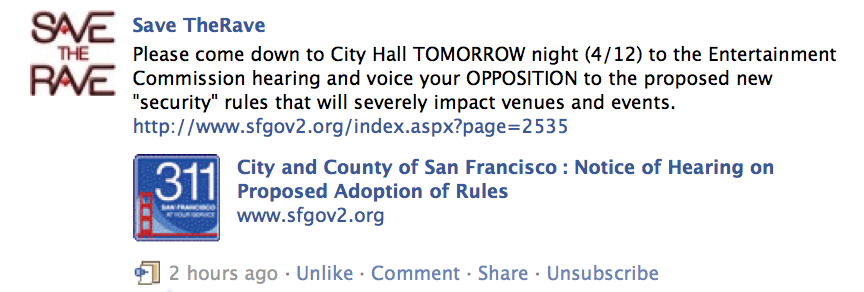
Save the Rave: Come down to City Hall TOMORROW night

Hot on the heels of last month’s joint San Francisco Youth and Entertainment Commission’s hearing on electronic dance music, we’re back with a sequel.   Now, in what Jim Harper of Cato calls a “jaw-dropping attack on privacy and free assembly“, the San Francisco Police Department has proposed onerous new conditions for permitting for all venues with more than 100 people.  For example:

3. All occupants of the premises shall be ID Scanned (including patrons, promoters, and performers, etc.). ID scanning data shall be maintained on a data storage system for no less than 15 days and shall be made available to local law enforcement upon request.

4. High visibility cameras shall be located at each entrance and exit point of the premises. Said cameras shall maintain a recorded data base for no less than fifteen (15 days) and made available to local law enforcement upon request.

Yikes!   As Deborah Pierce of Privacy Activism says, “We go to clubs to relax and spend time with friends. Knowing that all of your interactions are being recorded and that those images may be matched to your driver’s license information and handed over to the police at any time chills all manner of speech and association.” Yeah really.   And there are issues from the business perspective as well; on his Facebook profile, Save the Rave organizer Liam Shy summed it up as “Increased unnecessary burden/right to privacy conerns = fewer events, fewer folks attending events.”  Indeed.

Continue Reading »

Personal
Tales from the Net
privacy

Comments (5)

Permalink

Save the Rave: AB74 improves, SFPD asks for ID Scans and Surveillance Cameras

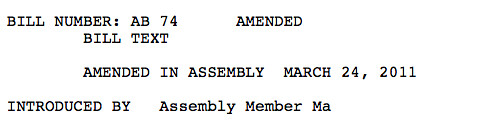
BILL NUMBER: AB 74 AMENDEDThis act shall be known and may be cited as the Raves Safety Act

Two days after the San Francisco Youth and Entertainment Commission’s hearing on electronic dance music at San Francisco City Hall, Hillary posted the amended language of AB74 in the Save the Rave Facebook group.  It’s a huge change.  Instead of criminalizing all electronic dance music events over 3 1/2 hours long the way the original bill did, it’s now focused on ensuring that promoters have a safety plan — and it only applies to events with more than 1000 people on state properties.  And a lot of the specific requirements are very sensible, for example the health and safety section should cover “whether the promoter should provide free water, whether the promoter should prohibit any person under 18 years of age from attending the event, adequacy of ventilation, attendance capacity, and exit signs.”

Hmm … where have I heard that before?

Continue Reading »

Tales from the Net
political
privacy
social computing

Comments (7)

Permalink

What next for the Social Network Users’ Bill of Rights?

Social Network Users Bill Of Rights

A broadly-recognized social network users’ bill of rights will be a huge step forward for online freedom and privacy. For me, and hundreds of millions of others, sites like Facebook, Twitter, tribe.net, and free-association are how I stay in touch with friends and family. As Voces Contra Las FARC, Barack Obama, #iranelection, and hundreds of other campaigns have shown, social network sites are also vital for political activism. And yet, today we the users of the sites have only minimal rights.

– me, in It’s time for a Social Network Users’ Bill of Rights, June 2010

Today’s SXSW panel Social Network Users’ Bill of Rights: You Decide is a great chance to rekindle the energy on the #billofrights (as we like to say on Twitter).   Panelists Christina Gagnier, Lisa Borodkin, and Jack Lerner all spoke at last year’s ACM Computers, Freedom, and Privacy conference last year when we crafted the document.*  Alex Howard of O’Reilly joins them.  Cool!  Check out the #snubor hashtag!

I like what CFP has done because I think they’ve covered all the bases, and they’ve done it with language that 95 percent of Web users can understand.

– Terry Sweeney, A Manifesto in the Name of Privacy, Internet Evolution

Since last June, the revolutions in Tunisia and Egypt have helped highlight the importance of social networks for political purposes, the Commerce Department has called for an online Privacy Bill of Rights — and ongoing news stories like A Chinese Activist and Mark Zuckerberg’s Dog continue to spotlight many social network sites’ challenges with free speech, and pseudonymity.  With this year’s CFP scheduled for Washington DC in mid-June, now’s a perfect time to get serious about organizing.

Continue Reading »

Tales from the Net
political
privacy
social computing

Comments (5)

Permalink

The top 23 privacy stories of 2010 and 2011

2010/11The Center for Democracy and Technology is running a Twtpoll on the biggest privacy story of 2010. 
Vote early and often!

Then come back and read the rest of this post.

Continue Reading »

privacy

Comments (2)

Permalink

What can Diaspora learn about security from Microsoft? (REVISED DRAFT)

See the final version here

Thanks to Adam, Jason, and Alem for the initial list; Sarah, tptacek, Locke1689, mahmud, Wayne, PeterH, Steve, and SonyaLynn for comments on the previous draft, and Damon for the wording on #7.

Continue Reading »

Professional
privacy

Comments (6)

Permalink

Creating the future at #cfp09: showtime for privacy and civil liberties activsm!

CFP logo

“Fight for me!”
– a privacy-loving Facebook friend, wishing me luck at the conference

Here’s our opportunity to realize the promise of the Net that was so present in 1990s when CFP started.
– Deborah Pierce on the CFP blog

The program for this year’s Computers, Freedom, and Privacy conference is outstanding even by CFP’s high standards.  The mix of technology, legal, policy, and activism perspectives is particularly strong this year, and with the new administration and Washington DC location there’s significant involvement by government employees for the first time since the 1990s.  As well as CFP regulars like Jennifer Grannick, Jim Harper, Ed Felten, Nicky Ozer, Alessandro Acquisti, Stewart Baker, and Lillie Coney, speakers incude first-timers like Marcy Wheeler, Dori Maynard, Paul Ekman, Shireen Mitchell, Rebecca Mackinnon, Nancy Scola, and Ari Melber.  Don’t take my word for it — check out the program and prepare to be impressed.

Best of all, with streaming video, the #cfp09 Twitter backchannel ,* live-blogging, and a community wiki, the conference will be more accessible onine than every before.    Kudos to Katy Nelson of the ACLU and Robert Guerra of Freedom House for taking the lead with the video streaming, and to all the volunteers of the online visibility team for all the great work on the blog, Twitter, and Facebook.  The online schedule has details, we’ll do our best to keep the web site updated regularly, and the Twitter feed will be best way to keep up what’s going on.

Continue Reading »

Personal
Tales from the Net
Uncategorized
privacy
social computing

Comments (2)

Permalink

Facebook reverts to previous TOS. A win for social network activism!

With over 90,000 members in the protest group on Facebook, EPIC (the Electronic Privacy Information Center) and other privacy organizations filing a complaint readying a complaint to file with the FTC, over 750 articles, and headlines like Facebook seems to have a trust problem, it’s not too surprising that Facebook decided to rethink their stance on the Terms of Service changes.

And sure enough, from Mark Zuckerberg’s Update on terms late last night:

Going forward, we’ve decided to take a new approach towards developing our terms. We concluded that returning to our previous terms was the right thing for now….

Continue Reading »

Tales from the Net
privacy
social computing

Comments (7)

Permalink

Zuckerberg: “we wouldn’t share your information in a way you wouldn’t want.” Oh really?

Mark Zuckerberg has a comment up on the Facebook blog in response to the firestorm about their new terms of service:

Our philosophy is that people own their information and control who they share it with. When a person shares information on Facebook, they first need to grant Facebook a license to use that information so that we can show it to the other people they’ve asked us to share it with. Without this license, we couldn’t help people share that information.

He then goes through the simple scenario of a user sending messages and then deleting his or her account.  Should the messages disappear?  Mark says no, and notes that this is also how email works.   Of course this doesn’t have much to do with the reasons why people are upset — what about photos, for example?  What about Facebook reserving the right to sub-license, i.e. profit from, the content that’s been deleted?  Hmm.

Continue Reading »

privacy
social computing

Comments (11)

Permalink

Facebook: all your content are belong to us. FOREVER! Protests ensue.

Facebook’s terms of service (TOS) used to say that when you closed an account on their network, any rights they claimed to the original content you uploaded would expire. Not anymore.

Chris Walters in The Consumerist

And people aren’t happy about it.  Anne Kathrine Yojana Petterøe’s People Against the new Terms of Service (TOS) protest group had about 900 members when I joined at 7:30.  By the time I posted this at 9:30 it was over 1650, which puts the growth rate at an astonishing 35%+ per hour.  After inviting another 50+ people on Facebook and retweeting, I sent mail to some colleagues encouraging them to check it out:

If you haven’t been tracking social network activism campaigns, this could be an intersting one.  The “call to action” in the protest group is very crisp; and it’s a great example of a campaign crossing social networks.

A Twitter search for “TOS” is a good way to follow the discussion; the Twitter #facebook hashtag is hopping as well.  Both have been in the top 10 trending topics on Twitter all morning, with TOS currently at #2.

Continue Reading »

privacy
social computing

Comments (11)

Permalink

Open for Questions at change.gov: What about privacy?

The Obama transition team’s Open for Questions pilot last week went extremely well for a first attempt.  Combined with all the other promising things Micah Sifry discusses in Kudos to the Change.gov New Media Team, it seems to me that the Obama administration is on track for some effective ways of leveraging cognitive diversity and “wisdom of the crowds” effects, cutting past the gatekeepers in the media, and getting Obama direct feedback from Americans.

At least for those Americans who are willing to give away their privacy as the price for interacting with their government.

Continue Reading »

political
privacy
social sciences

Comments (11)

Permalink

Creating the future: Computers, Freedom, and Privacy 2009

CFP logo

From conference co-chairs Cindy Southworth and Jay Stanley’s Call for presentations, tutorials, and workshops:

The 19th annual Computers, Freedom, and Privacy conference is now accepting proposals for panels, workshop sessions, and other events.

CFP is the leading policy conference exploring the impact of the Internet, computers and communications technologies on society. It will be taking place in June 2009, just months into a brand new U.S. administration — an exciting moment in history, as we look into the future and ask, “Where do we go from here?” For more than a decade, CFP has anticipated policy trends and issues and has shaped the public debate on the future of privacy and freedom in an ever more technology-filled world. CFP focuses on topics such as freedom of speech, privacy, intellectual property, cybersecurity, telecommunications, electronic democracy, digital rights and responsibilities, and the future of technologies and their implications.

We are requesting proposals and ideas for panels, plenaries, debates, keynote speakers, and other sessions that will address these and related topics and how we can shape public policy and the public debate on these topics as we create the future.

More information, and a link to the submission form, here.  The submission deadline is December 19 January 23.

CFP has always been a meeting ground for different perspectives: academics, privacy advocates, corporate types, government, activists, and at times hackers and students.  The quality of presentations is high, and there’s a good mix between big names and “not the usual suspects”.   Washington DC, six months into a new administration that’s being described as “the first internet presidency”, with privacy and civil liberties issues on the table … it should be a particularly good year!

Continue Reading »

Professional
Tales from the Net
privacy
social computing

Comments (2)

Permalink