#iranelection and a sea of green on Twitter: at the forefront of social network activism

“The first step that I suggest as a solution is that we Iranians, no matter where we live in the world, strengthen the social ties among ourselves…. This is where the power of our social network resides.”

– Mir Hussein Mousavi, quoted in Ehsan Moghaddasi’s The Green Moharram

Continue Reading »

Tales from the Net
political
social sciences

Comments (29)

Permalink

Social network activism and the future of civil liberties

Also posted on The Seminal and Pam’s House Blend

The most recent skirmish on the Patriot Act reauthorization battle ended badly for civil liberties.   Despite passionate speeches all around in the Senate Judiciary Committee public hearings and classified briefings, in the end, only Senators Feingold, Durbin, and Specter stood up for the Constitution. As Marcy Wheeler says, we got rolled.

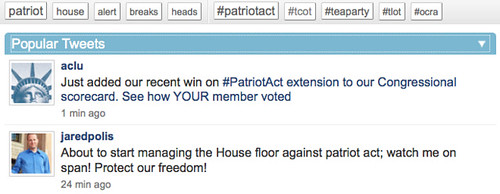
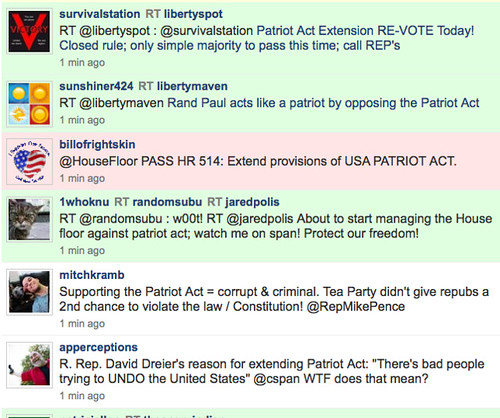
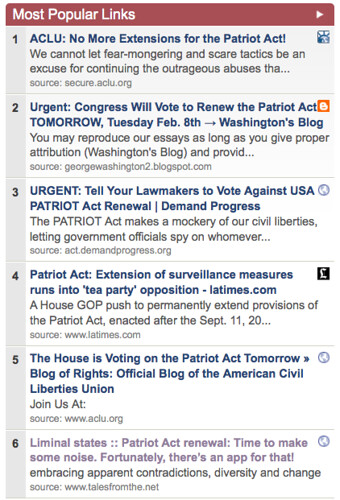
At the same time, though, the social network activism I discussed in Can Skittles fix the Patriot Act? and on the Get FISA Right blog highlights the opportunity to broaden and recharge the civil liberties community.

Twitter, Facebook, MySpace, Care2, OFA and other social network sites:

  • provide a way to engage with Millennials and other diverse groups of people who care a lot about the Patriot Act — but are not currently involved with civil liberties activism.
  • make it easy for people to let their politicians know their feelings — and recruit their friends in the process.
  • allow civil liberties organizations to get beyond the media blackout and provide accurate information to everybody.
  • complement in-person local campaigns like People’s Campaign for the Constitution’s local ordinances and good ol’ fashioned letters-to-the-editor

It’s a powerful narrative.  Social network sites epitomize the wave of the future, Obama’s strength in 2008, and youth.  They’re overwhelmingly in favor of civil liberties.  And civil liberties supporters are getting organized there.  As we continue to make progress, every political consultant and politician thinking about a primary or general election challenge in 2010 or 2012 will be paying attention.

Social network activism for civil liberties has made great progress so far.  Some simple steps from organizations and bloggers can take things to the next level.  Before getting to the suggestions, though, I’d like to discuss the diversity aspects in a little more detail.
Continue Reading »

Tales from the Net
political
social computing

Comments (2)

Permalink

Social network activism and the Patriot Act (DRAFT)

DRAFT Work in progress! Feedback welcome!

Final version intended for The Seminal and Pam’s House Blend

Continue Reading »

Uncategorized

Comments (12)

Permalink

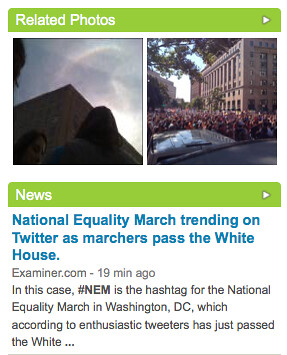
National Equality March: some highlights via Twitter

Some screenshots from the #nem hashtag via Twazzup:

2009-10-11_1020

Continue Reading »

Uncategorized

Comments (0)

Permalink

Can Skittles help fix the PATRIOT Act and FISA? (DRAFT!)

DRAFT!  Final version published on The Seminal.

Continue Reading »

Tales from the Net
political

Comments (1)

Permalink

Ask @bing to create grants for nonprofit advertising on their site (DRAFT)

Update, September 1: Microsoft responded.  More here.

Draft!  Work in progress!  Feedback welcome!

Continue Reading »

Uncategorized

Comments (1)

Permalink

Iran, censorship, social networks — and hundreds of thousands of people risking their lives

new photos from today in Tehran from @mousavi1388

“I think the filters and the restrictions have been going on for so long in Iran that the experienced people are already prepared for this,” said Jon Pincus, a former Microsoft project manager and digital activist who works on projects promoting online freedom.

Iranians dodging internet censorship , Doug Gross, CNN

The OpenNet Initiative’s Cracking down on digital communication and political organizing in Iran is a good summary of the situation there, and their research report has a lot more details.  Thus far, at least, the internet is largely routing around censorship: despite severe filtering by the government, Twitter, Facebook, Flickr, and YouTube have played huge roles in the protests.

The Mir Hossein Mousavi میر حسین موسوی Facebook page is one important example, updated regularly with instructions and requests for help and information.  Tuesday, when the sites hosting the “guide to cyber-warfare in Iran” were going down under DDoS attacks, they sent a link to a text version of this to all the supporters.  This is a very efficient way to get credible information distributed broadly internationally, in easy-to-forward form — and even when Facebook is blocked in Iran, information can flow back into the country through whatever other channels are open.

Continue Reading »

Uncategorized

Comments (3)

Permalink

Twittering in the Trenches: a workshop on social networks at #cfp09

Along with Deborah Pierce, Shireen Mitchell, and Ari Melber, I’m presenting n the Twittering in the trenches workshop today at Computers, Freedom, and Privacy conference.

If all goes well, it’ll be streamed at http://www.ustream.tv/channel/cfp09 … and the Twitter hashtag is #cfp09.

Deborah’s post on the CFP blog has some background.  Check it out!

I’ll be at CFP all week … stay tuned for more.  For now, here’s the program.

Uncategorized

Comments (0)

Permalink

Users: #fixreplies. Twitter: “No. Thanks for the great feedback!”

twitter logoRetweet this. If you disagree with Twitter’s decision to hide replies to ppl you don’t follow, start your replies with #fixreplies.

– @nazgul (aka Kee Hinckley), on Twitter

56000 tweets later, in We learned a lot, Twitter founder @biz admitted that the “user feedback” they had cited as part of their original decision didn’t include Twitter users who liked discovering new people or participating in various conversations.   [This isn't not particularly surprising, since the company's founders don't use the service the way most users do, and these days appear primarily focused on celebrities rather than real people.]

Biz also admitted that user feedback wasn’t actually what drives their decisions:
Continue Reading »

social computing

Comments (7)

Permalink

#p2 and prioritizing diversity: background reading for Thursday’s tweeting

#p2 tweeting* Thursday April 30

7-8PM Pacific/10-11PM Eastern
Draft agenda and discussion here
Please join us!

#p2 logoTwitter is an opportunity to engage with communities currently marginalized by the “progressive blogosphere”

– Tracy Viselli and Jon Pincus, The #p2 Hashtag and Strategies for Progressives on Twitter on The Exception

#p2 is a resource for progressives who prioritize diversity and empowerment

– #p2’s wiki and Twitter profile

Because #p2 (aka “progressives 2.0″) is the closest thing to a broad communication mechanism for progressives on Twitter so far, I’m not sure how many people realize that the primary focus is on diversity. So here’s some background reading about #p2 for Thursday’s tweeting  on how progressives can organize more effectively on Twitter.

Let’s start with a question that I think doesn’t get asked enough.

Do progressives care about diversity?

Continue Reading »

political
social computing

Comments (2)

Permalink

Equal Pay Day: #fairpay and Women don’t ask

Blog for fair payAccording to new data from the Bureau of Labor Statistics, in 2007 the ratio of women’s and men’s median annual earnings reached almost 78 cents on the dollar for full-time year-round workers, up from just under 77 cents in 2006. This is the narrowest the wage gap has ever been, but it’s only an additional one cent on the dollar. One cent is chump change. It isn’t real change.

– from AAUW’s Equal Pay Day, April 28

African-American women earn 62¢ and Latinas earn 53¢ for every dollar earned by white, non-Hispanic men. #fairpay #fem2 #p2

– @NWLC on Twitter

One of President Obama’s first actions in late January was signing the Lilly Ledbetter Fair Pay Act into law.  That’s only a first step, though; the next battle in the fight against wage discrimination is the Paycheck Fairness Act.  The PFA updates the 45-year-old Equal Pay Act in many important ways, and passed the House with strong bipartisan support, and is currently before the Senate as S.182.

The AAUW’s site has a bunch of ways you can help: call your Senators, wear red,* blog about it, share on Facebook and join their group and cause, and tweet about it using the #fairpay hashtag.  It’s all important; do as much as you can.  There are a couple of things I’d specifically like to highlight.

Let’s start with Twitter, where this is another great opportunity for hashtag-based diversity activism.  Activity via #fairpay accomplishes several things.  Most obviously, it raises awareness: whenever you tweet, all your followers are reminded of the wage gap.  If some of the Twitterati start retweeting, or there’s enough activity that #fairpay winds up in the top 10 “trending” hashtags, a lot more people will see it.  So tweet away!  If you’re not sure what to say, the National Women’s Law Center has some tweeting points you can use as inspiration.

Continue Reading »

political
social computing
social sciences

Comments (4)

Permalink

Twitter *is* a strategy (UPDATED draft)

DRAFT!  Work in progress.  Feedback welcome!

UPDATE, April 27: This thread sparked and tied in with substantial discussion elsewhere — see the bottom of the main post for additional links.  I developed my thoughts in Cognitive evolution and revolution, which I presented at Politics Online; the blog post and comments also document a couple of successful examples of Twitter as a strategy for diversity in male-, white- and elitist-dominated environments. I wonder why it’s so hard for some people to accept that (1) I know what strategy is, (2) I’ve been treating Twitter as a strategy, and (3) it’s working?  Meanwhile, Charlotte-Anne Lucas’ The Twitters tells the story from #isoj is another proof point which illustrates language and geography diversity.   So I’ll try to kick off the conversation again.  More here.


Too often, Twitter is the enemy of complex thought, not its friend — if you’re on Twitter yourself, look at your last few weeks’ posts and see what fraction of your potential mental capability they actually express. Probably not much: that’s not what the tool is good for.

– Colin Delany in Twitter is not a strategy on e.Politics and techPresident

Yeap – Twitter is NOT a Strategy | http://ow.ly/1vIN

– @IsCool, on Twitter

Help me make #CA10 the next skittles. We can do this. #gov20 #opengov #p2
Adriel Hampton on Twitter

Somebody’s missing what’s going on here and I don’t think it’s Adriel.

Continue Reading »

Tales from the Net
Uncategorized
political
social computing

Comments (70)

Permalink